
Note: This was a piece I wrote in April for the Madrid Review, which has a new issue out this week, the first edited by Jayne Marshall. I also recommend the Sobremesa podcast for informed commentary on Spanish politics.
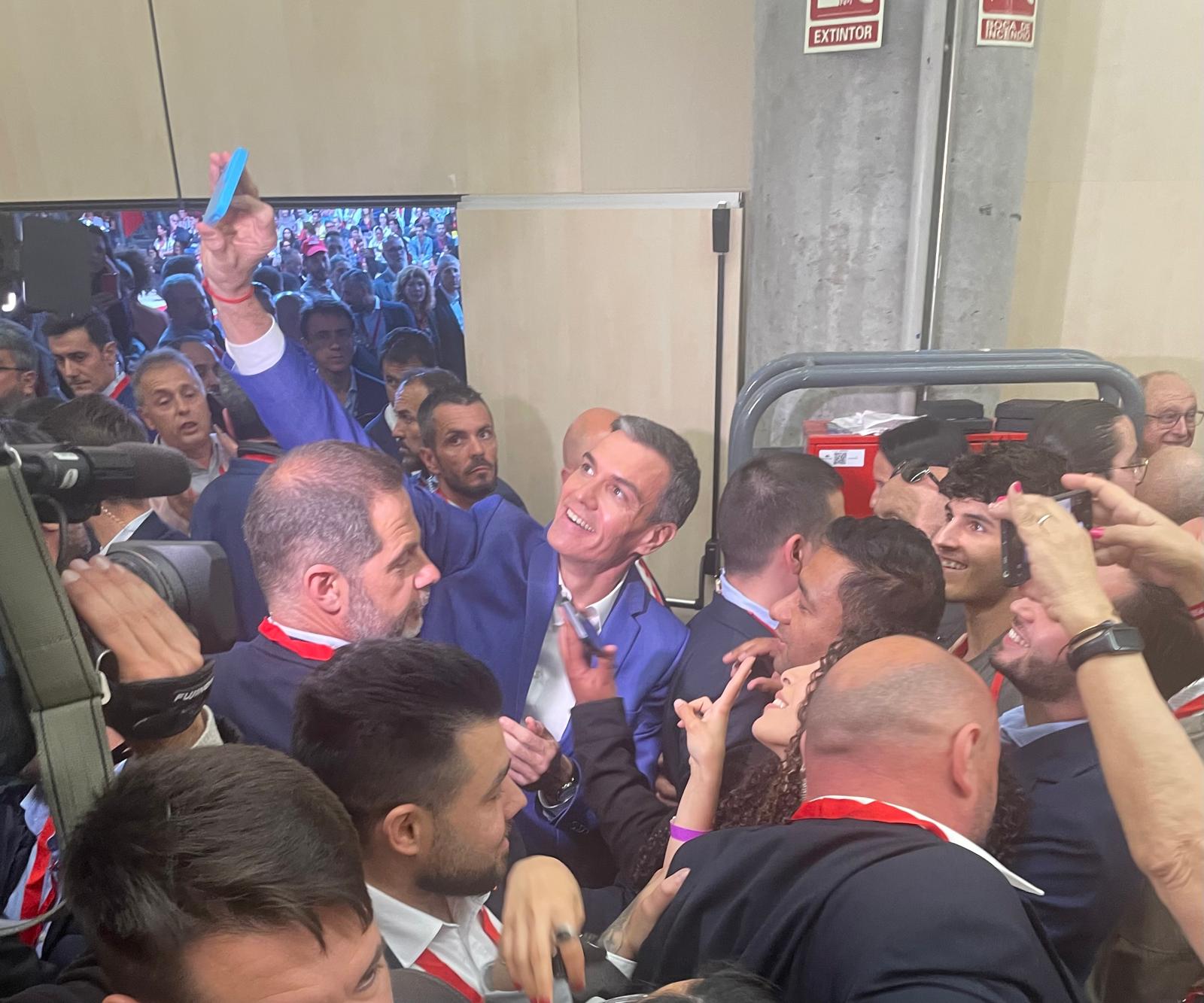
The Global Progressive Mobilisation—held this past weekend in Barcelona—was a triumph for Spanish prime minister Pedro Sánchez and his Socialist party, which organized the inaugural meeting. Hundreds of speakers from dozens of countries were represented during the two-day gathering, which brought together politicians, government officials, academics, and activists. The event culminated on Saturday, April 18 with a plenary session attended by 6500 people in the main hall of Fira Gran Via, the convention center located in Barcelona’s Hospitalet neighborhood. American politicians Chris Murphy and Tim Walz delivered remarks during the plenary, with video messages from Bernie Sanders and Zohran Mamdani.
“The reality is that the tools that the right wing are using to try to destroy our democracy are similar from country to country,” Murphy told Reuters in an interview. “We need to share experiences to understand how we can fight back.” The address from Murphy, whose book Crisis of the Common Good will be published next month, begins at the four-hour mark of the plenary, which is available in its entirety online.
There were a remarkable range of speakers, including Mohammad Shtayyeh, the former Prime Minister of Palestine, who said: “I only regret one thing. That the prime minister of the state of Israel was not invited to see that the whole world is standing against him.” (The following day—not even 24 hours later, as La Vanguardia put it—Sánchez called on the European Union to end its association agreement with Israel.) Sánchez’s opposition to war was praised throughout, including by Italy’s Elly Schlein, who addressed him directly: “Thanks for using four simple words: no a la guerra … we will not replace international law with the law of the strongest and richest.”
Several of the speakers also noted the Hungarian election, held on April 12.
“The preeminent gangster authoritarian in the world, next to my president,” said Neera Tanden, CEO of the Washington D.C.-based think tank Center for American Progress, “suffered a massive defeat.” She noted that Viktor Orbán lost, after sixteen years in power, by ignoring the needs of ordinary people, suggesting there’s a parallel to what’s happening in the US. A recent example she offered is that the war in Iran has caused gas prices to rise more in the last month than in the previous sixty years.
One of the refrains of the meeting was that opposing authoritarian governments was not enough, and concrete proposals to further the progressive agenda needed to be brought forward. And many were: the Associated Press reported that South African president Cyril Ramaphosa will present a draft resolution to establish an International Panel on Inequality at the U.N. General Assembly in September. Mexican president Claudia Sheinbaum said that governments ought to spend 10% of their military budgets on reforestation projects. “Each year, instead of planting the seeds of war, we will plant the seeds of life,” the AP quoted her as saying.
Two more compelling ideas were brought forward during the panel “Reclaiming the Economy: Green Industrial Policy Beyond Neoliberalism,” which featured economists Mariana Mazzucato and Isabella Weber alongside ministers of finance Dario Durigan, from Brazil, and Spain’s Carlos Cuerpo. Mazzucato announced that she was working with Cuerpo to form the Global Council for a Common Good Economy: an international council of leading economists committed to working with progressive governments.
Weber, a member of the council, also made a specific policy proposal in response to oil shortages as a result of the Iran war. As outlined in a recent piece co-written with Gregor Semieniuk for Project Syndicate, she called on the European Union to take the lead in forming a global alliance—an oil buyers’ club—that would prevent oil prices from fluctuating unpredictably. Participating countries would agree to limit the price (a monopsony: like a monopoly, but on the demand side) of buying crude, which would be “a mechanism for spreading the cost more equally, building solidarity among importers, and preventing costly bidding races while the emergency lasts.”
Weber and Semieniuk acknowledged that a plan requiring cooperation between nations to defy the market might seem “utopian” but noted a similar scheme for allocating raw materials occurred between allied countries during World War I. A more recent historical precedent, which Weber had a role in implementing, came during the pandemic: the gas-price cap imposed by the European Union. In 2022, Weber served on a German commission to develop how the country would institute price controls on gas, a remarkable measure that demonstrated the ability of governments to impose regulations on private businesses to protect citizens from surging energy bills. (Full disclosure: my agency Vesto handled the publicity for Weber’s first book How China Escaped Shock Therapy, which was published in 2021. Her metamorphosis into a public intellectual advising policy makers—by which point we remained in correspondence, but were no longer working together on publicity matters—was recounted by The New Yorker.)
The meeting closed with remarks from Sánchez, who said the far right has only caused “war, inflation, inequality, and social discord.” It was a rousing address to close the plenary, assuring the crowd that the far right’s days are numbered. There was a more delicate speech that Sánchez gave a few days earlier, at Tsinghua University, in which he offered a vision for a “multipolar” world. That April 13 address in Beijing has been widely praised, called “important” by El País and “historic” by the economist Branko Milanovic.
“In my opinion, what is happening today is not a transfer of hegemony,” Sánchez said. “It is a multiplication of poles — not only of power, but also of prosperity . . . for the first time in history, many places around the world are taking strides forward simultaneously. Places, moreover, that are not alike.” In a final call for cooperation, he invoked the Artemis II astronauts’ glimpse of the earth from space.
“They saw our planet for what it is: a miraculous blue sphere without borders. We human beings are the result of that miracle. And therefore our duty is to understand one another and to cooperate so that this miracle may continue to flourish.”